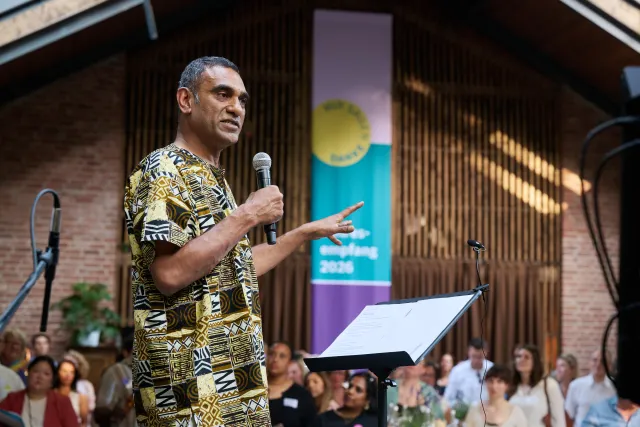
In a recent podcast you state that activism as usual is no longer enough. What did you mean by this?
KN: This is a moment in history that calls for brutal honesty. While activism has achieved much, activism as usual is no longer enough in this time of converging crises. At least with climate change, we have a chance to recover, even though we are very close to the climate catastrophe cliff. But we are not winning at the scale and speed required.
Too often, we are speaking loudly, but to each other. We have built echo chambers of the convinced, while those we most need to reach remain untouched. Quite often, we are also speaking in a theoretical language, in a scientific language, and we are not really taking people with us.
So what needs to change in the way that movements organize and communicate today?
KN: First, we must move from fragmentation to unity. Power is organized. Too often we are not. We need to pick up the powerful concept of intersectionality. We need to understand that our different issues, economic justice, environmental justice, racial justice, gender justice, and so on are connected.
“This is a moment in history that calls for brutal honesty.”
Second, we must stop relying only on facts and policy arguments. The science is clear, the data is overwhelming. Yet inequality deepens, global emissions rise. Why? Because we are not reaching people in their hearts and souls. People are not moved by facts and figures alone. Culture drives politics. Politics does not drive culture. We must embrace new forms of storytelling, culture, and creativity. Movements must become as compelling as the forces we oppose.
Can you give an example here?
KN: Fossil fuel corporations, for example, invest billions in shaping narratives and misinformation. If we can't come up with the billions, we have to ask ourselves how we can match that investment on their side with imagination and creativity that overcomes the power of their advertising dollars.
Also, we haven’t sufficiently rooted leadership in the Global South, where 88 per cent of the world's population live. They're not just victims. We have to see them as leaders. If we listen, we find that the future is already being practiced in many parts of the world.
Which turning points shaped your understanding of social change?
KN: My life has been shaped by both pain and politics. The loss of my mother changed me when I was 15, but it also pushed me. One of my father's friends, who was an activist, suggested to live with purpose and work for the dignity of others. And that was the most useful advice I found. Growing up in the Apartheid system taught me that injustice is not abstract. It is designed. It's normalized, but it also can be dismantled. My exile period after I fled at the age of 22 to the UK taught me that solidarity can cross borders.
Returning to South Africa in 1990 after Nelson Mandela's release taught me that change requires both resistance and institution building. And later working globally for Amnesty International, among others, taught me something sobering. Even when we win politically, systems of inequality can reinvent themselves.
For me, the most painful recent turning point was losing our son Riky Rick, who was a prominent South African rapper. In the last conversation his mom and I had with him, he said you guys aren’t that good at what you do because you aim all your narratives at the brain and you ignore the heart, the body, and the soul.
What is at stake at the moment – and how do activists have to respond?
KN: This moment in history calls on us to be creatively maladjusted. We need to push back on the cognitive dissonance and denial that exist as to how close to the climate cliff we really are and how, in fact, democracy is being undermined in countries that supposedly were promoters of democracy in the past. None of us thought we’d be dealing with climate denialism from the United States government, with the illegal wars, with the undermining of international law, the cutting off of aid, and the rise of racism. We thought we were moving away from all of that.
“I cannot remember another period in history where the appetite for substantive structural and systemic change was is as high as it is now.”
But there is good news, too. I cannot remember another period in history where the appetite for substantive structural and systemic change was is as high as it is now. What is needed right now is system innovation, system transformation, and system redesign instead of what we generally have, which is system recovery, system protection, and system maintenance. So that's the challenge of the moment we find ourselves in.
You are part of the Global Artivism Movement. What is its core idea?
KN: The biggest crisis we have is the crisis of imagination. Our policy makers, and activists alike, are struggling to imagine a world that is more equal, more just, more sustainable, more fair, more peaceful. And we need artists to help us with that imagination journey. The most important thing that art can offer is to imagine realities that are yet to be born.
Artivism is about closing the gap between what we know and how we feel. We know we are in crisis, but we do not yet feel it deeply enough to act with urgency. Art has a unique power to bypass our defense. It speaks to memory, identity, imagination. It can make injustice visible in ways that reports and speeches cannot. So, through the Global Artivism Movement and collaborations with artists like Olafur Eliasson, we are asking this question: How do we make people feel that the climate crisis, inequality, and injustice are not distant issues, but lived realities?
What are the most important questions that activists should be asking today?
KN: Beneath climate change, inequality, and democratic erosion lies a deeper crisis of values. We have built systems that prioritize profit over people, growth over well-being, extraction over care. So, we have to ask ourselves, what kind of world do we want to leave to our children? What are we willing to change, give up, or fight for to get there? And crucially, who is missing from the table when decisions are made?
If we ask these questions, honestly, I believe we will see that the answers already exist, and particularly in young people who are demanding justice. They are not contaminated by the bad experiences of our generation. Young people have the most to lose. And the most to gain, if we get it right. And that is why it is not surprising that with the climate crisis, everywhere in the world, young people are at the forefront. I hope that their voice continues to grow.
Kumi Naidoo
Residence: June 2026 – September 2026
How can activists act more convincingly and effectively in times of multiple crisis? And how can imagination and the concept of artivism contribute to creating a more equal, just, and sustainable world?