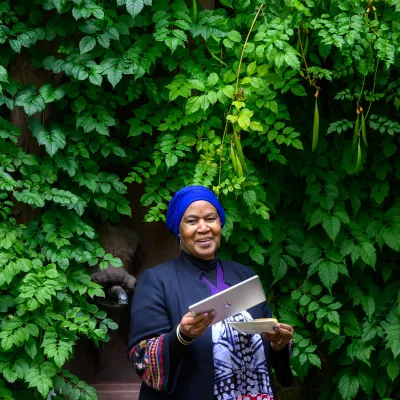
Phumzile Mlambo-Ngcuka
More about Phumzile Mlambo-Ngcuka
Phumzile Mlambo-Ngcuka speaks about education as the defining experience of her life. Growing up under apartheid in Clermont, near Durban in South Africa, she watched her mother run literacy classes from the family home for adults who had never had the chance to learn. The image of grown people discovering they could read, write, count, and then manage their own lives has never left her.
She studied arts and education in Lesotho after being barred from studying in South Africa for organizing protests during the 1976 Soweto uprising. Monitored by security authorities and with a fiancé in prison for his activism, she taught as a high school teacher in South Africa and led the Natal Organization of Women. In 1984, she joined the World YWCA in Geneva, working on international youth programs while quietly building support for the isolation of apartheid South Africa.
Her formal political career began in South Africa's first democratic Parliament in 1994. She served as Deputy Minister of Trade and Industry, Minister of Minerals and Energy, and from 2005 as Deputy President, the first woman to hold that office. In these years, she championed the “Joint Initiative for Priority Skills Acquisition” (JIPSA), designed to bridge the gap between qualifications and employment.
After leaving government in 2008, she founded the Umlambo Foundation, which works with over sixty schools in South Africa, and serves as Chancellor of the University of Johannesburg. She also completed a doctorate at the University of Warwick on mobile learning and teacher development in under-resourced schools. From 2013 to 2021, she served as Executive Director of UN Women, where she launched the HeForShe campaign and mobilized $40 billion in commitments for gender equality.
In 2026, Phumzile Mlambo-Ngcuka is a Richard von Weizsäcker Fellow at the Robert Bosch Academy, studying how Germany prepares young people for the world of work and exploring what lessons may travel back to South Africa and to the African continent to ready the world’s fastest growing young population for their emerging economies.
Resumé
1955 Born in Clermont, near Durban, KwaZulu-Natal, South Africa
1976 Expelled from South African university during Soweto uprising; leaves to study at the National University of Lesotho
1980 Bachelor of Arts in Education, National University of Lesotho
1980–1981 Lecturer, Mpumalanga Teachers Training College
1981–1983 Teacher, Ohlange High School, Inanda, KwaZulu-Natal
1983 First president, Natal Organization of Women (NOW), UDF affiliate
1984–1989 International Youth Director, World YWCA, Geneva
1985 Marries Bulelani Ngcuka, twelve days after his release from political detention
1988 Qualification in Gender Policy and Planning, University College London
1990–1994 Development and civil society work, Cape Town
1994 Elected to South Africa's first democratic Parliament
1996–1999 Deputy Minister, Department of Trade and Industry
1999–2005 Minister of Minerals and Energy
2003 Master’s degree in Philosophy (Educational Planning), University of Cape Town
2005–2008 Deputy President of South Africa – first woman to hold the position
2008 Resigns following President Mbeki's recall; founds the Umlambo Foundation
2013 Doctorate in Technology and Education, University of Warwick
2013–2021 UN Under-Secretary-General and Executive Director, UN Women
2022–present Chancellor, University of Johannesburg; IOC Chairperson of Human Rights Commission; board roles including Mercedes-Benz SA
2026 Richard von Weizsäcker Fellow, Robert Bosch Academy, Berlin
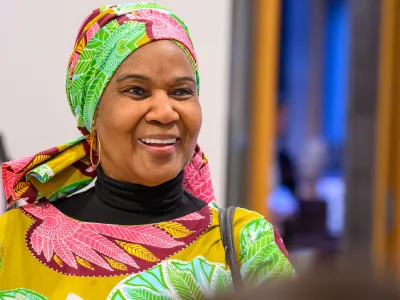
Phumzile Mlambo-Ngcuka's Richard von Weizsäcker Fellowship
Preparing African youth for the world of work
Africa has the fastest growing and largest youth population on earth. By 2050, one in four people in the global labor force will be African. Whether this becomes an opportunity or a crisis depends almost entirely on one question: can African education systems prepare young people to participate successfully in the 21st-century world of work? Currently, Phumzile Mlambo-Ngcuka holds, too many of them do not meet the requirements of Africa’s emerging economies.
A gap that has not closed
Phumzile Mlambo-Ngcuka knows this problem from many perspectives: As Deputy President she championed JIPSA – the Joint Initiative on Priority Skills Acquisition – a national drive to close the gap between the qualifications South Africa was producing and the skills its economy needed. The frustration was acute: graduates with degrees but no experience, and no mechanism to acquire it. Internship pathways were created; young South Africans were placed abroad. Some came to Germany. Yet, two decades later, the structural disconnect remains.
What Germany can teach
Germany's dual vocational training system – combining classroom learning with workplace experience – is one of the most studied models in the world for connecting education to labor markets. As a Richard von Weizsäcker Fellow, Phumzile Mlambo-Ngcuka intends to understand how it works from the inside: what conditions made it possible, what it actually delivers, and what is genuinely transferable to very different contexts. She plans to engage with employers, training institutions, policymakers, and young people themselves.
Taking it back
As part of her fellowship, she is set to deliver concrete policy proposals for South Africa and a broader contribution to the debate about African youth and the future of work. She also brings a clear conviction about what that future requires: education that is built around problem-solving, that produces job creators rather than job seekers, and that takes young people seriously – not as recipients, but as agents.