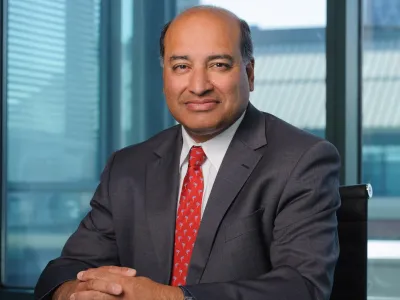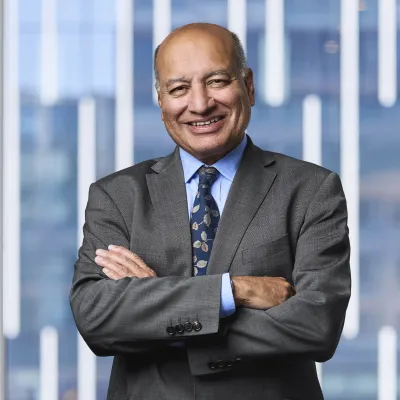
Suma Chakrabarti
More about Suma Chakrabarti
“On a trip to India as a kid, I was completely hit by the poverty I was seeing in the Calcutta main station.” The experience would shape Suma Chakrabarti’s four-decade career in international development — and his enduring question of what makes development efforts actually work. Ever since, empathy has been an integral part of his job as foreign advisor.
Chakrabarti began his professional journey as an ODI Fellow in Botswana from 1981 to 1983, where he worked on cost-benefit analyses of infrastructure projects. This experience exposed him to the realities of development policy on the ground and shaped his long-standing engagement with emerging economies. “One of the reasons why I'm able – most of the time – to connect with people of different cultures is because my own cultures are mixed,” says Chakrabarti, who was born in the West Bengal region of India but moved to England with his parents as child.
Following his time in Botswana, Chakrabarti joined the UK Civil Service, holding leadership positions across departments including HM Treasury, Cabinet Office, Ministry of Justice and the Department for International Development. In these roles, he worked at the intersection of policy, governance and implementation in complex institutional settings.
In 2012, Chakrabarti became President of the European Bank for Reconstruction and Development, a position he held until 2020. During his tenure, he oversaw the bank’s strategic expansion and deepened its engagement with countries transitioning to market economies. Since then, he has continued to contribute to global development as Chair of the Board at ODI Global, as an Independent Director of ReNew Energy Global PLC, as an adviser to the presidents of Kazakhstan and Uzbekistan, and as a member of the board of the UK Competition and Markets Authority.
As a Fellow of the Robert Bosch Academy in Berlin in 2026, Chakrabarti examines when and how foreign advisers to emerging markets can succeed. Drawing on his experience, he explores the political, technical, and personal factors that determine whether advice is implemented effectively.
For Chakrabati, empathy is a prerequisite of advisory work in international development. “Working with foreign government leaders, you need to understand where they're coming from,” he says. “What is motivating them? What are they frightened of? You have to actually understand their characters for your advice to have impact.”
Resumé
April 2026–today Member of the board of the UK Competition and Markets Authority
July 2020–today ODI Global; Chair of Board of Trustees
August 2021–today ReNew Energy Global PLC;Independent Director
October 2020–today Adviser to President of Uzbekistan
October 2020–September 2024 Adviser to President of Kazakhstan
Juli 2012–Juli 2020 European Bank for Reconstruction and Development (EBRD); President
2007–2012 Ministry of Justice UK;Permanent Secretary
2002–2007 Department for International Development (DFID); Permanent Secretary
1984–2002 ODA, HM Treasury, Cabinet Office, DETR, DFID; Various UK Civil Service Roles
1981–1983 ODI; ODI Fellow Botswana
Suma Chakrabarti's Richard von Weizsäcker Fellowship
During his Richard von Weizsäcker Fellowship, Suma Chakrabarti examines why foreign policy advice to emerging market governments succeeds in some cases but not in others. Drawing on over four decades of experience he focuses on what enables advice to be effectively received and implemented.
The project is structured around three dimensions:
- The political economy of advisory work (roles, independence, vested interests),
- The technical context (scope, data, institutional and cultural understanding)
- The personal qualities required of advisers beyond technical expertise.
Through interviews with officials and experts in Germany, France, the UK, and the EU, as well as case studies from Botswana, Kazakhstan, and Uzbekistan, Chakrabarti brings together perspectives from both advisers and recipient governments.
The fellowship will culminate in a paper outlining how foreign advisers can more effectively contribute to governance and development in emerging markets.