The “system” did not silence Alireza Eshraghi when he started out as a twenty-something journalist, hopeful to make a difference during Iran’s brief reform era at the turn of the millennium. On the contrary: it invited him to speak, as it did so many others through “Free Tribunes”, “Free-Thinking Platforms,” and student debate tournaments. The reformist daily he joined, Hayat-e No, was even run by a brother of the Supreme Leader Ali Khamenei. Alireza became the youngest senior editor in the country. It looked as if the “nezam” – the closed system of Iran’s clerical rulers – might, after all, be argued into opening.
Then, in 2002, it put him in a cell in Iran’s notorious Evin Prison for fifty-three days: Solitary confinement, for publishing a tiny cartoon dating back to 1938. It showed US President Franklin D. Roosevelt at odds with the Supreme Court, his face smaller than a fingernail. The drawing illustrated an interview about rising divorce rates, nothing to do with politics. Yet, the “nezam” claimed, didn’t the face resemble that of Ayatollah Khomeini, the revolution’s founder?
That was all it took to bring charges of treason and espionage against the 22-year-old. Those charges have never been dropped by the regime. What did end, however, was Alireza Eshraghi’s belief that debate would necessarily lead to change. What to do instead is the question that drives him to this day.
Alireza Eshraghis own game
Alireza Eshraghi got through the fifty-three days by going inward. They had taken his glasses and left the light burning day and night. With nothing to read, he studied the marks earlier prisoners had scratched into the wall to count their days. The longest count was forty. When his own fortieth day came and went, “I was really crushed.” He held on for thirteen more.
What he worked out in that cell is that the invitation had been hollow all along. The debate wasn’t debate. The dialogue was the control. The regime opened spaces for argument so that it could be aired, contained, and then left to peter out without ever reaching power. “It wasn't open to genuine persuasion,” he says. “The other side had already made up its mind.” Those who used the spaces most sincerely – reformists, journalists, Eshraghi himself – were lending the “nezam” the very credibility of a debate it never meant to honor. Their dissent became the system’s alibi.
It still does. The system still lets dissent run – unlike in Saudi Arabia, China or Russia, “every front page is criticism at some level” – because permitted criticism never has to be acted on. The dissent stays inside the frame and the frame holds, Alireza Eshraghi says. Only once did he see that frame break, he continues with a hint of awe: When women took off their headscarves to protest against having to wear them in 2022, they stopped arguing on the regime's terms altogether. “I'm not playing this game in your field anymore,” as he puts it. “I'm choosing my own game.”
“Imagine a revolution as big as the French Revolution or the Russian Revolution.”
Alireza Eshraghi had learned early how fast a world can turn upside down. Born in 1978, two months before the Islamic revolution, he grew up in an old Isfahan family whose standing the new regime swept away. One of his uncles had been Iran's ambassador to Australia and Mexico, about to be posted to Washington, another had been head of Iran’s Red Crescent and mayor of the ancient city of Isfahan. “He had overseen the beautification of Isfahan – its parks, its urban landscaping”, Alireza Eshraghi says. “Then he was arrested by the new regime, tried in a kangaroo court, and summarily executed.”
The Iran-Iraq War brought new violence to his hometown. Alireza Eshraghi was eight when a bomb struck the spot near his school where he and his friends used to meet. He was not there that day. “I lost a couple of dear friends. Another friend lost his eyes, another got paralyzed.”
“These were traumatic events, and they shaped my life — maybe for good, because of what I learned through the resilience: navigating muddy and murky waters.”
He did not see any of this as trauma at the time: the word did not exist in his world then, he says. What it left him with instead was a strange ease in uncertainty, and resilience – the “capacity to navigate muddy and murky waters,” as he calls it.
“Democracy movements have fewer and fewer chances.”
After Evin he could not stay. He left Iran in 2007, took fellowships at Berkeley and the University of North Carolina at Chapel Hill and completed a doctorate in communication, its title the lesson of his first life: Debating the Limits of Debate. By 2011, he was Director of Programs for the Middle East, South Asia and North Africa at the Institute for War and Peace Reporting (IWPR). The initiatives he designed and led have helped hundreds of organizations develop communication and advocacy strategies, improve processes and operations, engage in grassroots mobilization, and leverage limited resources to address systemic challenges and empower communities.
He has worked with civil society leaders across more than forty countries. And it was there, among the activists and the organizers, that the same question which had beset him in Iran caught up with him – in a new variation. Once it had been: how do you change a system you cannot trust? Now it was: how do you get people to act together when they do not trust each other?
Again and again, he watched the same thing happen, he says. Community leaders who had spent years building trust saw it dissolve in hours, because a stranger tweeted something. “And people would trust that tweet rather than the very people they know, the people they had broken bread and had salt with. So how can we still even think of having a community?”
“We thought that by just arguing, we could persuade them. But it didn't work.”
Alireza Eshraghi sounds exasperated, and lays much of the blame on social media also in Western democracies: “There has been so much abuse of trust. Everything in the past ten, fifteen years has become storytelling. Why should you trust a story just because it's nice?” In the age of social media, “it’s not even post-truth anymore. We can’t agree on reality”, he says. His conclusion is bleak: “Democracy movements have fewer and fewer chances.”
Staying in the ante-chamber
So how can democracies survive, and citizens still act together if trust is dying? It is this theme that Alireza Eshraghi plans to work on in Germany, a society straining under its own pressures of polarization and fracturing trust – and a society marked by two great historical ruptures – 1945 and 1989 – after which it had to remake the basis on which people lived and worked together.
His question is not how to restore trust, but what forms of solidarity and action can emerge without it. The answer, he suspects, could lie in lowering expectations: not the deep, all-or-nothing trust of a shared cause, but something thinner and more tactical. “Trust is cognitively, socially, and emotionally expensive.” Cooperation may be one option he says: “Cooperation is not necessarily trust-based”, he says. “You don't have the luxury of picking and choosing. You have to go with the one that is the most feasible, the safest, and is working, but you also need to build structural commitments that makes showing up easier than opting out.”
And then he reaches for an image. “In many Asian cultures you have two rooms for visitors. One larger one for general guests – they don't get access to the rest of the house. And then, if you are intimate enough, if you have trust, you let them inside.” He pauses. “Now is the time, perhaps, to think of those bigger rooms.”
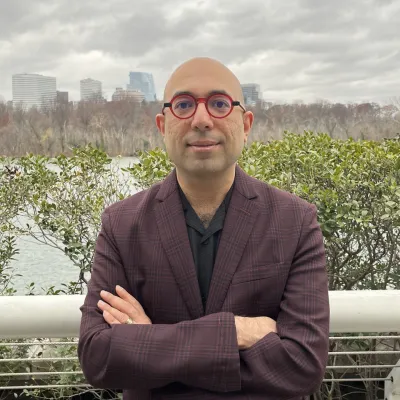
Alireza Eshraghi
Residence: July 2026 – December 2026
How can people build community and bring about change when societies are polarized and trust is in short supply? And can systems that people have no confidence in be changed from within?