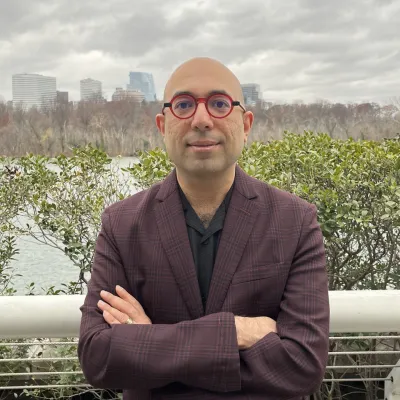
Alireza Eshraghi
How can people build community and bring about change when societies are polarized and trust is in short supply? And can systems that people have no confidence in be changed from within?
More about Alireza Eshraghi
Alireza Eshraghi has spent his life inside the question he brings to Berlin: Born in Isfahan in 1978, two months before the Iranian Revolution, he grew up in a socially and politically prominent family whose world was shattered – first by the new regime, then by the bombings of the Iran-Iraq War. In his twenties, during the brief opening of the Khatami reform era, he became one of Tehran's youngest senior newspaper editors, convinced that argument and debate could bring a closed system to change.
They could not: In 2002, after his paper published a tiny caricature, he was jailed for 53 days in solitary confinement in Iran's notorious Evin Prison. He was released after international protests but banned from journalism and from university and eventually left Iran for the United States in 2007. There, he rebuilt his life as a scholar and a practitioner. He earned a doctorate in communication from the University of North Carolina at Chapel Hill, while training and coaching civil society leaders and community organizers in more than forty countries, At the Institute for War and Peace Reporting (IWPR) he has launched several public scholarship and technical assistance programs to help civic actors increase their creative, organizational, and operational capacity.
That work has led him to a sobering observation: Across polarized societies, whether in Tehran or even in the United States and Europe, the foundations that once made collective action possible are crumbling. Confidence in institutions, media, experts, and even in one another has eroded, and social media can dissolve years of patient community-building in hours.
Most responses ask how to rebuild trust. Eshraghi asks something more radical: what if trust can no longer be assumed at all? And how can we act together anyway? During his fellowship at the Robert Bosch Academy, he is exploring whether there are alternatives, rather than trust, that might become the basis for community and change in an age of uncertainty.
Resumé
1978 Born in Isfahan, Iran
1997 Begins studying Political Science at Imam Sadeq University, Tehran; enters journalism in the same year as Iran's reformist press emerges
1997–2007 Managing Editor, Editor-in-Chief and Senior Editor at Iran's leading reformist dailies, including Shargh, Hayat-e No, Hamshahri Diplomatic, Asia, Jahan Sanat and Bayan
2002 Earns combined B.A./M.A. in Political Science, Imam Sadeq University; arrested and held in solitary confinement at Evin Prison; awarded Iran's National Journalism Award
2002–2005 Juror, Iran's National Journalism Award (the country's equivalent of the Pulitzer Prize)
2008 Leaves Iran; Fellowship in New Media, Graduate School of Journalism, UC Berkeley
2008–2010 Visiting Scholar, Institute of International Studies, and Research Fellow, Religion, Politics and Globalization Program, UC Berkeley
2009 Graduate Certificate, Graduate School of Journalism, UC Berkeley
2009–2011 Managing Editor, MENA, Institute for War & Peace Reporting (IWPR) in partnership with McClatchy syndicate of newspapers
2010–2012 Rotary World Peace Fellow, Duke-UNC Center for International Studies in Peace & Conflict Resolution
2011–present Director of Programs, Institute for War & Peace Reporting (IWPR), designed and launched several initiatives advocating for peace, gender equality, civic participation and independent media
2012 Graduate Certificates, Duke-UNC Center for International Studies in Peace & Conflict Resolution and Duke-UNC Consortium for Middle East Studies
2012–2016 Instructor, Department of Communication, University of North Carolina at Chapel Hill
2013 M.A. in Communication, University of North Carolina at Chapel Hill
2017–present Advisor, International Civil Society Action Network (ICAN); Member, Women's Alliance for Security Leadership (WASL)
2018–present Curriculum Manager, Center for Community Health and Development, University of Kansas – developed the organizational coaching program for community organizers
2020 Ph.D. in Communication, University of North Carolina at Chapel Hill (dissertation: Debating the Limits of Debate: Politics and Rhetorics of Dissent and Disagreement in the Islamic Republic of Iran)
2020–present Visiting Scholar, Center for Middle East and Islamic Studies, UNC-Chapel Hill
2022–present Founder and Editor-in-Chief, Daneshkadeh – the first Persian-language open-access platform for public scholarship in the social sciences and humanities
2026 Richard von Weizsäcker Fellow, Robert Bosch Academy, Berlin
Alireza Eshraghi's Richard von Weizsäcker Fellowship
Beyond Trust: Building Community and Collective Action in an Age of Uncertainty
As a Richard von Weizsäcker Fellow, Alireza Eshraghi is pursuing a question that reaches well beyond any single country: how can communities hold together and act together when trust is in short supply? Across the world, the ground beneath collective life is shifting, he says. Confidence in institutions, media, experts, and even in one another is eroding, and social media can dissolve years of patient community-building in a matter of hours. For the civil society leaders, peacebuilders and organizers Eshraghi has worked with in more than forty countries, the old foundations of bringing people together – shared narratives, institutional legitimacy, interpersonal trust – can no longer be taken for granted.
What can work when trust is missing?
Rather than asking how to restore trust, Eshraghi intends to research what forms of solidarity and common action are possible even without trust. Can people only build on trust, or could trust emerge as a result rather than a prerequisite when other factors are at play. What can work even without trust: what allows coalitions to form, movements to sustain themselves, and communities to act once the certainty that underpinned cooperation is gone? Can guarded alliances – tactical, interest-based, honest about their limits – be an answer to the lack of trust?
Why Germany?
Eshraghi is drawn to the two ruptures of Germany's recent history: the rebuilding of society after 1945, and the upheaval of reunification after 1989. Both were moments when a society had to remake the basis on which people lived and worked together, he says. After 1945, a country discredited by dictatorship and war had to construct democratic institutions and a new civic consensus. After 1989, two populations shaped by different political systems and cultures had to grow together. In both cases, trust between people and in institutions had to be built, or rebuilt, under pressure. Eshraghi wants to understand how that happened, how far it succeeded, and where it did not. And what, if anything, might transfer to other societies facing their own crises of cohesion today?
As a Richard von Weizsäcker Fellow, Eshraghi aims to pursue these questions within broader debates on democracy, technology, and collective futures, and through exchange grounded in real experience.