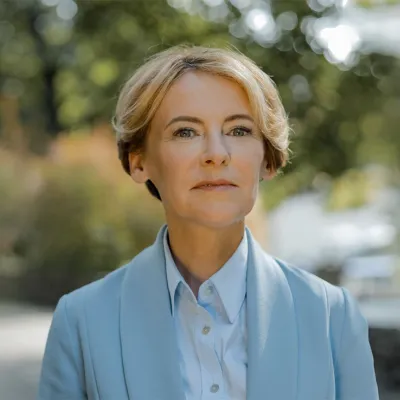
Marija Golubeva
How do we build the resilience and deterrence needed to defend the European project from hybrid attacks? How do we meet the threat from Russia and other authoritarian actors who target not just individual member states, but our shared infrastructure, energy independence, and the narratives that hold us together?
More about Marija Golubeva
Marija Golubeva was born in 1973 in Riga, then occupied by the Soviet Union, into a Russian-speaking family. After degrees in English philology at the University of Latvia and history at the Central European University in Budapest, she won a scholarship to Cambridge, where she wrote her PhD under Peter Burke on the political representation of Emperor Leopold I (1640–1705) of the Holy Roman Empire. Her research examined how court historians, ceremony and image-making were used to construct and legitimize imperial authority.
She built a career in policy research and consulting, working on education, migration and integration policy across the Western Balkans, Central Asia and Eastern Europe for clients including the European Commission, the Council of Europe and the Latvian government. In 2010 she co-authored Shrinking Citizenship, documenting how political language in Latvia systematically narrowed democratic participation. In 2018 she entered parliament as co-founder of Movement For!, a liberal, pro-European party. In 2021 she became Minister of the Interior of Latvia, leading a ministry of approximately 15,300 employees. She was the country's first openly lesbian minister. She resigned in May 2022 following a coalition crisis.
Since leaving office, Golubeva has focused on hybrid warfare: the use of cyberattacks, physical sabotage and disinformation to destabilize open societies. She co-founded Meleys, a crisis simulation company, and is a fellow at the Hertie School's Center for International Security in Berlin. As a Richard von Weizsäcker Fellow at the Robert Bosch Academy, she is investigating how Russia and other authoritarian actors are targeting not just individual member states but the European project itself – and what resilience and deterrence measures are needed to defend it.
Resumé
1973 Born in Riga, Latvia
1990–1994 BA in English Philology, University of Latvia, Riga
1994–1995 MA in History, Central European University, Budapest
1995–2000 PhD in History, University of Cambridge – thesis on political norms and ideology in Burgundian and Habsburg court historiography, c. 1470–1700
1999–2001 Lecturer in Cultural History, Latvian Academy of Culture, Riga
2000 Publication: The Glorification of Emperor Leopold I in Image, Spectacle and Text. Verlag Philipp von Zabern, Mainz
2001–2002 Acting Head, Department of Political Science, Riga Stradiņš University
2003–2004 Consultant, State Chancellery (Cabinet Office), Latvia – functional audit of public agencies as part of Latvia's public administration reform
2004–2012 Senior Researcher & Advocacy Officer, PROVIDUS (Center for Public Policy), Riga – policy analysis and recommendations in education, migration, and integration policy; clients included UNDP Latvia, Open Society Institute, and Network of Education Policy Centers
2010 Publication: Shrinking Citizenship: Discursive Practices that Limit Democratic Participation in Latvian Politics (with Robert Gould). Rodopi
2013–2014 Senior Consultant, ICF, Brussels – policy research and advice for EU institutions; led EU Aid Volunteers Preparatory Action (DG ECHO); managed teacher education reform project for the Western Balkans (DG EAC); co-authored EU Aid Volunteers training standards
2013 Publication: Models of Political Competence: The Evolution of Political Norms in the Works of Burgundian and Habsburg Court Historians, c. 1470–1700. Brill's Studies in Intellectual History 220, Brill, Leiden
2014–2016 Development Director & Head of Migration Policy Programme, PROVIDUS, Riga – led migration and integration policy research; managed consultancy for Latvian government, Open Society Institute, and Renaissance Foundation Ukraine
2014–2018 Senior Consultant / Owner, RHC Consulting, Latvia – policy advice on education, development aid, and humanitarian assistance; clients included the European Commission, Council of Europe, and the Latvian Ministry of Foreign Affairs; field work in Western Balkans, Ukraine, and Central Asia
2017–2018 Senior Non-Key Expert, Quality Education Support Programme (Tajikistan), Human Dynamics – EU-funded education reform; developed teacher needs assessment and self-evaluation tools
2018–2022 (45) Member of Parliament, Latvian Saeima (13th) – Kustība Par! (Development/For!); member of National Security Committee and Education, Culture and Science Committee; member of Parliamentary Presidium
2022 Chair, European Affairs Committee, Latvian Parliament – coordinated Latvian national positions for EU Councils
Feb–May 2023 Richard von Weizsäcker Fellow, Robert Bosch Academy, Berlin – research on innovation in EU support for Ukraine and Moldova since the outbreak of the Russian war in 2022
2021–2022 Minister of the Interior of Latvia, Government of Latvia (Kariņš Cabinet I) – led Home Affairs sector (~15,300 employees; annual budget up to €500 million); introduced Digital Nomad Visas; developed Latvia's response to the Ukraine refugee crisis; represented Latvia in the EU Justice and Home Affairs Council; Latvia's first openly LGBTQ+ minister
2022–present International Consultant, RHC Consulting, Latvia – policy advice on democracy, security, migration, and development cooperation; clients include EU institutions and bilateral donors
2024–2025 Chief of Party, Zinc Network
2023–present Co-Founder, Meleys – AI-powered crisis simulation and strategic communications platform; leads scenario design and hybrid threat training for government and defense clients
2024–present Non-resident contributor, Center for European Policy Analysis (CEPA), Washington D.C. – regular commentary on EU security, Baltic defense, and Eastern Partnership policy
2026 Richard von Weizsäcker Fellow, Robert Bosch Academy, Berlin

Marija Golubeva's Richard von Weizsäcker Fellowship
Europe Under Attack: Building Resilience and Deterrence for the Euro pean Project
The European project – not just individual member states – has become the primary target of hybrid attacks by Russia and other authoritarian actors. That is Marija Golubeva's central hypothesis, and her Richard von Weizsäcker Fellowship sets out to test and substantiate it. Across three domains – shared infrastructure, energy independence, and political identity – she argues that the attacks of the past four years form a coordinated strategy aimed at the foundations of the EU itself.
Three domains of attack
In her research, she analyzes patterns of hybrid attacks between 2022 and 2026. The first domain covers physical attacks on the infrastructure that underpins EU interconnectedness. The second covers attacks on European energy independence. The third covers information campaigns designed to undermine the EU's political identity and narrative – particularly around European defense and enlargement.
Her argument is that these are not separate incidents but a systematic effort to erode the idea of Europe as a coherent political project.
From diagnosis to action
During her fellowship, Marija Golubeva intends to combine research with practice. She plans to convene a roundtable bringing together security and defense experts alongside EU and rule-of-law specialists, bridging two communities whose discourses rarely meet. She will also design and run a scenario-based simulation of a hybrid attack on Germany and other EU member states. In doing so, she plans to address a core weakness of current security architecture: it is still built around member-state attribution rather than EU-level response.
Her aim is to produce concrete recommendations for policymakers and civil society. Her conviction, drawn from years of running crisis simulations, is that resilience without deterrence is not enough: Europe must show that it has teeth.