“If Europe goes down as a project, there may be no safe space for individualists like me to live in,” says Marija Golubeva. “And I’m passionate about being an individualist.” It is a personal statement, but also a research agenda. As a Richard von Weizsäcker Fellow at the Robert Bosch Academy, the Latvian historian, former minister, and co-founder of the crisis simulation company Meleys is investigating how hybrid threats – Russian disinformation, sabotage, cognitive warfare – are eroding the civic trust that holds open societies together. The question is not abstract for her. She has been testing its limits since childhood.
“I was not happy with the Soviet school, mildly speaking.”
Marija Golubeva was born in 1973 in Riga, then occupied by the Soviet Union, into a Russian-speaking family. Her parents – with roots in Russia and Ukraine – did what they could to shield her from the system. Home was a safe space, school was not. When she skipped a May Day parade, her school principal rebuked her: “The state is not yet asking you to go and sacrifice your life for our Soviet motherland, but this was like a rehearsal.”
Her response, delivered silently, was “Exactly. And that is why I am not going”. Her private English teacher had coffee-table books about Cambridge and Oxford – an illicit aspiration in a Soviet household. “I would look for hours at those pictures of old colleges and lawns and primroses blooming in spring,” she remembers. After independence, and degrees in Latvia and Budapest, she eventually won a scholarship to Cambridge, where she wrote her PhD on Emperor Leopold I (1640-1705).
“I was interested in how human society functioned before the state.”
The late medieval world fascinated her precisely because of what it lacked: “I liked exploring a world without nation states,” she says. “How different functions were distributed be tween different institutions, individuals and communities.” Guilds, city councils, universities, monasteries – institutions built by what she calls “public-minded collectives,” serving human needs and offering people multiple niches to inhabit. The nation state replaced that plurality with a single system – and that always carries a risk, she says: “If you don’t fit in one system, there is no other system to go to.”
“My attitude towards policy work has always been: try to change something where you think it matters.”
The Soviet school had already taught her what that felt like. So had growing up Russian in an independent Latvia that was still working out who belonged and who not. “You suddenly find out that people consider you guilty because you are born in a certain kind of family,” she says. She unequivocally identifies herself as Latvian, but she also understands the mechanisms of exclusion from the inside. In her 2010 book Shrinking Citizenship, co-authored with Robert Gould, she documented how political language in Latvia systematically narrowed who counted as a full member of the democratic community.
“I did not fall in love with a gender; I fell in love with a person.”
There was a third identity to navigate. Marija Golubeva met her partner Diana Ieleja as a 20 year-old student in Riga. They have been together for more than thirty years and married in Brussels. “I did not fall in love with a gender,” she told a Latvian magazine in 2021. “I fell in love with a person.” Working as a consultant in Tajikistan, they had to pretend to be “just friends.” In Latvia, she became the country’s first openly lesbian minister in 2021.
“Suddenly I had so many people unhappy with me on the internet.”
Marija Golubeva entered parliament in 2018 as co-founder of Movement For! (Ķustiba Par!), a liberal, pro-European party that deliberately rejected Latvia’s ethnopolitical fault lines. As Minister of the Interior from 2021 she reformed police education, led Latvia’s response to the Ukraine refugee crisis, and wrestled with the Belarus border crisis, trying to protect both the EU’s external frontier and the families with young children arriving at it.
In May 2022 she was gone. A gathering of Russian speakers at Riga’s Soviet Victory Monument had given the nationalist coalition partner an ultimatum. The Prime Minister yielded. “What does it say about Latvian resilience if an insignificant gathering of a few hundred people standing for two hours can shake the government?”, Marija Golubeva commented in her final press conference. Only later, studying hybrid threats, did she recognize the pattern: “About five or six months before elections, individual politicians in leading positions who are perceived as vulnerable start being attacked en masse on social media. I had no idea that it wasn’t just by chance.”
“It’s undermining trust that we can manage ourselves.”
She packed her things into the car and headed south. Two months with Diana in rural southern Italy, then Berlin, and her first Richard von Weizsäcker fellowship. Now she is back for a second one, and the question that began in a Soviet schoolroom has become her central research concern.
What hybrid warfare does is not primarily spread false facts, Marija Golubeva argues. “What illicit campaigns target is not information, but behavior.” She describes an increasing phenomenon: In the first minutes after any unexplained incident – a drone, an explosion, a closed airport –, the information space is flooded with false information before any official information exists. The goal of these interventions through fake news sites and bot networks – driven by Russia and other actors – is not to convince people of something specific but to undermine people’s trust in their governments and European institutions. It’s all about “fear of fragmentation. And then, of course, scapegoating,” Marija Golubeva says.
“I see Europe as a safe space where individuals can exercise their individual agency and their ability to be themselves.”
Today, she runs crisis simulations through Meleys to test exactly these gaps. In Daugavpils, a city in eastern Latvia with a large Russian-speaking population, she asked local NGO leaders and municipal officials to work through a hybrid attack scenario together. What she found was not incompetence; it was the absence of trust. One NGO leader told her directly: “Sharing information in a crisis is a matter of trust. We would not share it with our city’s authorities.”
“European democracy is in genuine danger.”
For Marija Golubeva, Europe is not an abstract project but a room that allows freedom for a multitude of people and ways of living. "I see Europe as a safe space where individuals can exercise their individual agency and their ability to be themselves,” she says. As a Richard von Weizsäcker Fellow, she plans to focus on what puts this project at risk. “I do think European democracy is in genuine danger,” she says. “The whole infrastructure that we need in order to continue functioning as societies is not owned by our democratically elected governments.” The answer, she argues, has to combine resilience with deterrence, and digital infrastructure that is not entirely at the mercy of corporations. Above all, she insists on what she calls “maintaining the human in the loop.”
When asked whether a life spent never quite fitting the world as given makes her pessimistic about democracy, she pauses. “I think there is always hope for those kinds of projects. But sometimes you have to go through a pretty dark forest. And it’s better if we manage to build bridges over the worst precipices.” She is, she adds with a slight smile, “just one of the very small bridge builders.”
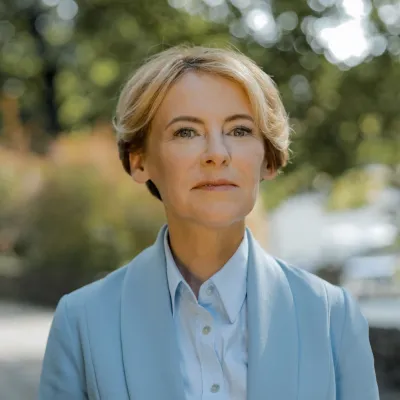
Marija Golubeva
July 2026 – September 2026
How do we build the resilience and deterrence needed to defend the European project from hybrid attacks?